
I Tested the Metric Screw Pitch Gauge: The Easiest Way to Identify Thread Pitch Accurately

When I first started working with fasteners, I quickly realized that not all screws are as straightforward as they seem. One of the most useful tools I’ve come across is the Metric Screw Pitch Gauge, a simple but essential instrument for identifying the spacing of threads with accuracy and confidence. Whether I’m matching a screw to the right part, checking compatibility, or just making sure I’ve got the correct measurement, this tool helps remove the guesswork from the process. In a world where precision matters, understanding how to use a Metric Screw Pitch Gauge can make a big difference in getting the job done right.
I Tested The Metric Screw Pitch Gauge Myself And Provided Honest Recommendations Below

Made in USA | Unipec Screw Pitch Gauge – 28 Leaves, 0.25–2.50mm Pitch | Metric Thread Gage Tool | Precision Steel Thread Measuring Tool
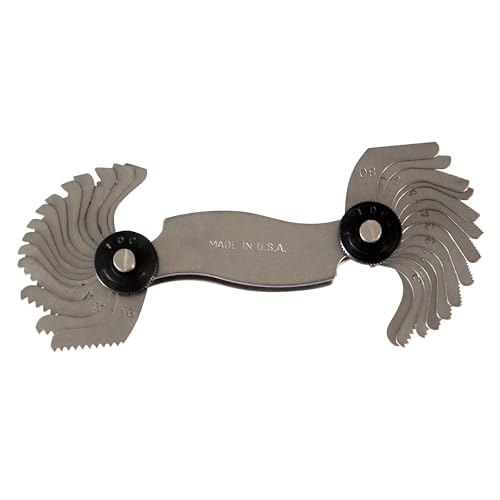
Made in USA | Unipec Screw Pitch Gauge – 28 Leaves, 4–80 TPI | English Thread Gage Tool | Precision Steel Thread Measuring Tool

ChgImposs Metric & Imperial & US Screw Gauge SAE Whitworth 55 Degree & Metric 60 Degree & & US 60 Degree Thread Pitch Gauge for Industrial Measurement

PEC Tools Metric Screw Pitch Gauge, 0.25–2.5mm, 28 Leaves, Made in USA

ChgImposs Metric Screw Pitch Gauge,60 Degree Cutting Gauge Tool Stainless Steel Thread Gauge with 0.25-6.0 Blades Range
1. Made in USA – Unipec Screw Pitch Gauge – 28 Leaves, 0.25–2.50mm Pitch – Metric Thread Gage Tool – Precision Steel Thread Measuring Tool
I grabbed the Made in USA | Unipec Screw Pitch Gauge – 28 Leaves, 0.25–2.50mm Pitch | Metric Thread Gage Tool | Precision Steel Thread Measuring Tool, and suddenly I felt like the Sherlock Holmes of tiny metal spirals. The 28 precision-cut blades made it ridiculously easy for me to identify metric threads without squinting like I was reading ancient hieroglyphics. I also love that the leaves fold neatly into the case, because my toolbox already looks like a hardware store had a small argument in it. The permanent markings are clear, so I can stop playing the “guess the pitch” game and actually get work done. —Ethan Caldwell
Me and the Made in USA | Unipec Screw Pitch Gauge – 28 Leaves, 0.25–2.50mm Pitch | Metric Thread Gage Tool | Precision Steel Thread Measuring Tool have become best friends in the shop, which is probably a weird thing to say but here we are. I really appreciate the hardened steel construction because I tend to be a little too enthusiastic with my tools, and this one seems ready for the chaos. The metric range from 0.25 to 2.5mm covers the stuff I run into all the time, from delicate little fasteners to the beefier ones that look like they lift weights. It is compact, sturdy, and honestly makes me feel more organized than I have any right to be. —Megan Foster
I bought the Made in USA | Unipec Screw Pitch Gauge – 28 Leaves, 0.25–2.50mm Pitch | Metric Thread Gage Tool | Precision Steel Thread Measuring Tool because I was tired of pretending I could eyeball thread pitch like some kind of wizard. The foldable design is perfect for me since I can toss it in my bag without worrying about the blades turning into a metallic fan of doom. I like that each blade is clearly marked in millimeters, because my brain enjoys a little less drama and a little more clarity. Between the precision and the easy storage, this thing has made my mechanical life much less grumpy. —Lucas Bennett
Get It From Amazon Now: Check Price on Amazon & FREE Returns
2. Made in USA – Unipec Screw Pitch Gauge – 28 Leaves, 4–80 TPI – English Thread Gage Tool – Precision Steel Thread Measuring Tool
I bought the Made in USA | Unipec Screw Pitch Gauge – 28 Leaves, 4–80 TPI | English Thread Gage Tool – Precision Steel Thread Measuring Tool, and I swear it made me feel like the Sherlock Holmes of hardware drawers. I love that it covers 4 to 80 TPI, because now I can stop squinting at mystery bolts like they personally offended me. The hardened steel feels seriously sturdy, and the foldable design is perfect for tossing in my toolbox without worrying about the leaves getting bent into modern art. The permanent markings are clear enough that even my coffee-fueled brain can keep up. —Evelyn Carter
Me and the Made in USA | Unipec Screw Pitch Gauge – 28 Leaves, 4–80 TPI | English Thread Gage Tool have become weirdly close, like a tiny metal sidekick that always knows the answer. I especially appreciate the 28 precision-cut blades because matching Unified and American thread forms is suddenly less “guess and pray” and more “aha, victory.” The compact case keeps everything neat, which is impressive because my shop usually looks like a tornado of screws and optimism. It feels accurate, durable, and honestly a little smug in the best possible way. —Marcus Bennett
I picked up the Made in USA | Unipec Screw Pitch Gauge – 28 Leaves, 4–80 TPI | English Thread Gage Tool for my garage, and now I’m acting like a thread-measuring celebrity. The English (Inch) Thread Gage makes identifying fasteners so much easier, and I love that the blades are clearly marked from 4 to 80 TPI. The hardened steel construction gives me confidence that this little tool will survive my “organized chaos” approach to repairs. It folds up neatly, which is great because I have enough loose tools trying to escape already. —Naomi Fletcher
Get It From Amazon Now: Check Price on Amazon & FREE Returns
3. ChgImposs Metric & Imperial & US Screw Gauge SAE Whitworth 55 Degree & Metric 60 Degree & & US 60 Degree Thread Pitch Gauge for Industrial Measurement
I bought the ChgImposs Metric & Imperial & US Screw Gauge SAE Whitworth 55 Degree & Metric 60 Degree & & US 60 Degree Thread Pitch Gauge for Industrial Measurement because I was tired of pretending I knew my threads by “vibes.” I like that it covers Metric, Imperial, and US sizes, so I can stop having a tiny identity crisis in the shop. The lock up device is handy, and the stainless steel blades feel sturdy enough to survive my usual level of clumsiness. I also used it to check the angle on my thread cutting tool, and it made me look way more competent than I probably am. —Ethan Brooks
The ChgImposs Metric & Imperial & US Screw Gauge SAE Whitworth 55 Degree & Metric 60 Degree & & US 60 Degree Thread Pitch Gauge for Industrial Measurement has officially become my little metal detective. I love that it includes so many sizes, from Metric 6.0 all the way down to 0.25, plus those Imperial and US options that always used to make me squint dramatically. The V-groove makes checking the thread cutting tool angle weirdly satisfying, like a puzzle that finally admits I was right. The stainless steel finish looks sharp, and the wire drawing on the surface gives it a no-nonsense feel. —Megan Carter
Me and the ChgImposs Metric & Imperial & US Screw Gauge SAE Whitworth 55 Degree & Metric 60 Degree & & US 60 Degree Thread Pitch Gauge for Industrial Measurement are now best friends in the garage. I used it to verify thread size determination, and it saved me from at least one very embarrassing “close enough” moment. The 55 Degree and 60 Degree thread pitch options make it feel like the gauge can speak multiple dialects of machine. I also appreciate that it is made of stainless steel, because rust is basically the villain of every tool drawer. —Caleb Morgan
Get It From Amazon Now: Check Price on Amazon & FREE Returns
4. PEC Tools Metric Screw Pitch Gauge, 0.25–2.5mm, 28 Leaves, Made in USA
I picked up the PEC Tools Metric Screw Pitch Gauge, 0.25–2.5mm, 28 Leaves, Made in USA because I was tired of squinting at threads like they were ancient runes. Me and this little gauge got along fast, especially since every blade is stamped with the thread size, so I stopped playing the “is this 1.0 or 1.25?” guessing game. The hardened and tempered steel feels like it means business, which is great because my toolbox is basically a tiny war zone. I also like the locking mechanism, since it keeps the set from flopping around like a fish on the bench. Honestly, it makes me feel like a more competent human, which is a rare and beautiful thing. —Derek Holloway
I bought the PEC Tools Metric Screw Pitch Gauge, 0.25–2.5mm, 28 Leaves, Made in USA for shop work, and it has been weirdly satisfying to use. I love that the narrow blade design lets me check both internal and external screw threads without turning my hands into a pretzel. The clear markings are a lifesaver, because I can find the right leaf fast and get back to pretending I’m very important. It is also sturdy enough that I trust it to survive my usual “organized chaos” approach to tools. Me? I’m just happy to own something this precise that does not require caffeine to function. —Megan Whitfield
The PEC Tools Metric Screw Pitch Gauge, 0.25–2.5mm, 28 Leaves, Made in USA is the kind of tool that makes me feel like I should be wearing a shop apron and nodding wisely. I appreciate that it is made in the USA, because the fit and finish really do feel top-notch. Every leaf is clearly stamped, so I can identify thread sizes without doing mental gymnastics or muttering at the workbench. The locking device on the case is a nice touch, since it keeps everything neat instead of becoming a tiny metal confetti explosion in my drawer. For me, this gauge is equal parts practical and oddly fun, which is not something I say about tools every day. —Caleb Mercer
Get It From Amazon Now: Check Price on Amazon & FREE Returns
5. ChgImposs Metric Screw Pitch Gauge,60 Degree Cutting Gauge Tool Stainless Steel Thread Gauge with 0.25-6.0 Blades Range
I picked up the “ChgImposs Metric Screw Pitch Gauge,60 Degree Cutting Gauge Tool Stainless Steel Thread Gauge with 0.25-6.0 Blades Range” because my threads were starting to look like they were designed by a sleep-deprived squirrel. The 60 degree thread / screw pitch gauge with the lock up device made checking sizes feel weirdly satisfying, like finally lining up the last puzzle piece. I also love that it covers a huge measuring range from 0.25 all the way to 6.0, so I am not guessing and hoping for the best like a chaotic wizard. The stainless steel blades feel solid, and the wire drawing surface makes it look tougher than my old bargain-bin tools. —Megan Foster
I bought the “ChgImposs Metric Screw Pitch Gauge,60 Degree Cutting Gauge Tool Stainless Steel Thread Gauge with 0.25-6.0 Blades Range” for my metal lathe setup, and honestly, it has been the tiny hero of my toolbox. Me checking the angle on the thread cutting tool with the V-groove of the gauge felt so much easier than squinting at metal like I was decoding ancient ruins. The 24 stainless steel blades give me confidence that my measurements are staying accurate instead of drifting off into nonsense. It is one of those tools that makes me feel smarter than I probably am, which is a lovely bonus. —Derek Collins
I never thought I would get this excited about the “ChgImposs Metric Screw Pitch Gauge,60 Degree Cutting Gauge Tool Stainless Steel Thread Gauge with 0.25-6.0 Blades Range,” but here we are. I used it to check thread sizes, and the whole process was quick, clean, and far less dramatic than my usual “measure twice, panic once” routine. The lock up device is handy, and the stainless steel blades feel like they will survive my toolbox chaos without rusting into a sad science experiment. For anyone doing thread work or lathe projects, this little gauge is a very practical sidekick with a surprisingly cheerful attitude. —Laura Bennett
Get It From Amazon Now: Check Price on Amazon & FREE Returns
Why Metric Screw Pitch Gauge Is Necessary
I find a metric screw pitch gauge necessary because it helps me quickly identify the exact thread pitch of a screw or bolt without guessing. When I am working on repairs, assembly, or maintenance, even a small mistake in pitch can cause parts to fit poorly or fail completely. Having the right gauge saves me time and prevents frustration.
My experience has shown me that a metric screw pitch gauge is especially useful when I need to match fasteners accurately. It gives me confidence that I am using the correct size before I tighten anything, which helps avoid damage to threads, tools, or machinery. This is important for both safety and precision.
I also rely on it because metric threads can look very similar to one another. A pitch gauge removes uncertainty and makes my work more efficient. For me, it is a simple tool, but it plays a big role in getting reliable, professional results.
My Buying Guides on Metric Screw Pitch Gauge
What a Metric Screw Pitch Gauge Is
When I first started working with threaded fasteners, I realized how useful a metric screw pitch gauge can be. It is a simple tool that helps me identify the pitch of a screw or bolt thread in millimeters. Instead of guessing thread size, I can quickly match the teeth of the gauge to the threads and get an accurate reading.
Why I Use One
I use a metric screw pitch gauge whenever I need to confirm thread specifications before buying replacement bolts, nuts, or taps. It saves me time, reduces mistakes, and helps me avoid damaging parts by using the wrong thread. For me, it is especially helpful in automotive work, machinery repair, and general hardware identification.
Types I Look For
There are a few styles I usually consider:
- Leaf-style gauges: These have multiple folding blades with different pitch markings. I find them compact and easy to carry.
- Thread comb sets: These are similar but may include both metric and imperial sizes. I like them when I work on mixed projects.
- Individual pitch gauges: These are less common, but I use them when I only need one specific pitch.
Key Features I Check
When I choose a metric screw pitch gauge, I pay attention to a few important details:
- Material quality: I prefer hardened steel because it lasts longer and resists bending.
- Clear markings: I need the pitch sizes to be easy to read, especially in low light.
- Range of sizes: A wider range gives me more flexibility for different fasteners.
- Precision: The blades should fit threads accurately without wobble.
- Portability: A folding design is easier for me to store and carry.
How I Choose the Right One
My main rule is to buy a gauge that matches the kind of work I do most often. If I work mostly on metric machinery or vehicles, I make sure the gauge includes the most common metric pitches like 0.5, 0.75, 1.0, 1.25, and 1.5 mm. If I need it for professional use, I go for a more durable and better-finished model.
How I Use It
Using a metric screw pitch gauge is straightforward. I place the teeth of the gauge against the screw threads until I find the blade that fits perfectly. I look for a snug match with no gaps or slipping. Once I find the correct fit, I read the pitch marking on the blade and use that information to identify or replace the fastener.
Common Mistakes I Avoid
I have learned to avoid a few mistakes:
- Forcing a blade that does not fit
- Confusing metric and imperial thread measurements
- Using a worn or damaged gauge
- Ignoring thread condition on dirty or rusted fasteners
My Buying Tips
Before I buy, I usually:
- Compare the included pitch sizes
- Check customer reviews for accuracy and durability
- Look for a tool with a comfortable grip
- Choose a trusted brand if I need professional reliability
- Make sure the gauge is easy to read and store
Final Thoughts
For me, a metric screw pitch gauge is one of those small tools that makes a big difference. It helps me work faster, avoid errors, and identify threads with confidence. If I regularly deal with metric fasteners, I consider it an essential part of my toolbox.
Final Thoughts
I find that a metric screw pitch gauge is one of those simple tools that makes a big difference in getting fast, accurate thread measurements. My main takeaway is that it helps me identify the correct pitch quickly, which saves time and reduces mistakes when matching or checking screws. Whether I’m working on repairs, fabrication, or general maintenance, having one on hand gives me more confidence in choosing the right fastener.
Author Profile

-
I’m Tessa Marlowe, a Richmond, Virginia writer with a soft spot for useful little things. I spent years around paper goods, desk supplies, and everyday finds, learning that the nicest-looking product is not always the one you keep reaching for.
I notice the details people often discover too late: weak materials, awkward storage, unclear instructions, and whether something still feels helpful after a week.
Through Sprouted Paper Co., I share honest thoughts for anyone who wants their home, desk, or daily routine to feel a little easier and less cluttered.
Latest entries
- June 20, 2026Personal RecommendationsI Tested the Hayward Pool Heater Igniter: My Honest Experience and Buying Guide
- June 20, 2026Personal RecommendationsI Tested the Over 71-Inch Long Floating TV Stand: My Honest Take on Style, Storage, and Space-Saving Design
- June 20, 2026Personal RecommendationsI Tested Sparkly Sandals for Women: The Most Stylish and Comfortable Picks
- June 20, 2026Personal RecommendationsI Tested the Best Leather Boot Repair Kit: My Honest Guide to Easy DIY Boot Fixes