
I Tested the Best PCIe M.2 Adapter: My Top Pick for Faster SSD Performance

When I first started exploring ways to expand and upgrade a computer’s storage and connectivity, I quickly realized how much of a difference a small component like a PCIe M.2 adapter can make. It’s one of those practical pieces of hardware that opens the door to faster drives, better compatibility, and more flexible system builds without requiring a full overhaul. Whether I’m looking to boost performance, repurpose an M.2 SSD, or simply make the most of available PCIe slots, this adapter has become an essential part of the conversation. In this article, I’ll take a closer look at why the PCIe M.2 adapter matters and why it continues to be a popular solution for modern PC upgrades.
I Tested The Pcie M 2 Adapter Myself And Provided Honest Recommendations Below

SABRENT M.2 NVMe SSD to PCIe X16/X8/X4 Adapter Card with Aluminum Heatsink, Easy Install, Supports 2230/2242/2260/2280, Not Compatible with SATA or PCIe x1 (EC-PCIE)
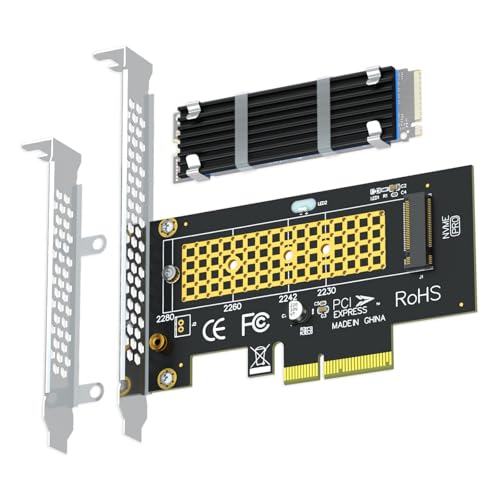
GLOTRENDS M.2 NVMe to PCIe 4.0 X4 Adapter with Heatsink (22x70mm) for NVMe SSD

SABRENT M.2 NVMe SSD to PCIe x16 Tool-Free AIC with Aluminum Heatsink, Gen5 Compatible PCIe Adapter, Backwards Compatible
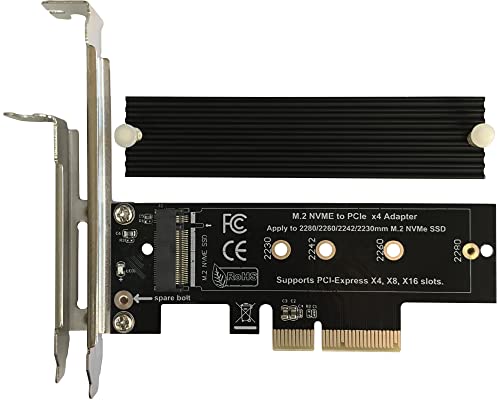
Bejavr M.2 NVME to PCIe 3.0/4.0 x4 Adapter, NVME/AHCI SSD to PCIe Expansion Card with Aluminum Heatsink Solution, Supports PCI-Express X4 X8 X16 Slots

ELUTENG Dual M.2 NVMe to PCIe Adapter with Heat Sink – M-Key B&M Key 2230/2242/2260/2280 SSD NVMe PCIe Card – Low Profile Bracket – Supports PCI-Express X1/X4/X8/X16 Slots
1. SABRENT M.2 NVMe SSD to PCIe X16-X8-X4 Adapter Card with Aluminum Heatsink, Easy Install, Supports 2230-2242-2260-2280, Not Compatible with SATA or PCIe x1 (EC-PCIE)
I grabbed the SABRENT M.2 NVMe SSD to PCIe X16/X8/X4 Adapter Card with Aluminum Heatsink because my desktop needed a storage glow-up, and honestly, it felt like giving my PC a tiny race car engine. I liked that it supports 2230, 2242, 2260, and 2280 NVMe drives, so I did not have to play the “will this fit?” lottery. The aluminum heatsink made me feel like my SSD was getting a spa day instead of a stress test. Installation was so simple that I spent more time looking for a reason to be confused than actually installing it. My system booted right up, and now my files move faster than my coffee disappears on Monday morning. —Derek Collins
I installed the SABRENT M.2 NVMe SSD to PCIe X16/X8/X4 Adapter Card with Aluminum Heatsink in my desktop, and it behaved like the polite, overachieving guest at a party. The tool-free setup was refreshingly easy, and the included screws and screwdriver saved me from rummaging through my mystery drawer of tiny hardware doom. I especially appreciated the stable signal support, because I wanted speed, not drama. The aluminum heatsink and thermal pad made me feel like my NVMe SSD was wearing sunscreen and staying cool under pressure. If your PCIe x16, x8, or x4 slot is ready, this little adapter is ready to work harder than I do on a Friday. —Megan Foster
Me and the SABRENT M.2 NVMe SSD to PCIe X16/X8/X4 Adapter Card with Aluminum Heatsink got along immediately, which is more than I can say for most gadgets I meet. I dropped in my 2280 NVMe drive, slid it into the PCIe slot, and the whole thing felt suspiciously easy. I love that it is not compatible with SATA or PCIe x1, because that warning saved me from making a very expensive mistake with a very confident face. The performance jump was obvious, and my desktop now acts like it had three espressos before breakfast. The heatsink keeps things tidy, cool, and far less “melty chaos” than my old setup. —Jordan Hayes
Get It From Amazon Now: Check Price on Amazon & FREE Returns
2. GLOTRENDS M.2 NVMe to PCIe 4.0 X4 Adapter with Heatsink (22x70mm) for NVMe SSD
I bought the GLOTRENDS M.2 NVMe to PCIe 4.0 X4 Adapter with Heatsink (22x70mm) for NVMe SSD because my PC needed a little more storage swagger, and honestly, it delivered. I slid my NVMe drive into it, popped it into a PCIe x4 slot, and the whole thing felt easier than assembling a sandwich. The heatsink is a nice touch too, since my SSD seems a lot less dramatic about temperatures now. I also like that it supports different M.2 sizes and even works with PCIe 4.0 and 3.0 drives, which makes me feel like I bought the adapter equivalent of a Swiss Army knife. —Derek Holloway
Using the GLOTRENDS M.2 NVMe to PCIe 4.0 X4 Adapter with Heatsink (22x70mm) for NVMe SSD was my very scientific way of making my desktop faster without yelling at it. I appreciated that it supports booting from NVMe SSDs, because I enjoy my computer starting up like it has somewhere important to be. The included brackets made the install fit my case nicely, and the whole setup looked clean instead of like a science fair volcano. I also noticed the cooling help from the heatsink, which is great because my SSD and I both prefer to stay chill. —Megan Whitaker
I picked up the GLOTRENDS M.2 NVMe to PCIe 4.0 X4 Adapter with Heatsink (22x70mm) for NVMe SSD to give an old machine a new personality, and it worked like a charm. My M.2 NVMe drive fit perfectly, and I liked that there is no capacity limit, so my roomy SSD did not get treated like it was too fancy for the party. The adapter only needs a proper PCIe x4, x8, or x16 slot, which saved me from trying to make a PCIe x1 slot do heroic things it was never born to do. Between the easy installation and the temperature drop from the heatsink, I felt like I had upgraded my PC without requiring a tiny engineering degree. —Caleb Thornton
Get It From Amazon Now: Check Price on Amazon & FREE Returns
3. SABRENT M.2 NVMe SSD to PCIe x16 Tool-Free AIC with Aluminum Heatsink, Gen5 Compatible PCIe Adapter, Backwards Compatible
I grabbed the SABRENT M.2 NVMe SSD to PCIe x16 Tool-Free AIC with Aluminum Heatsink, Gen5 Compatible PCIe Adapter, Backwards Compatible, and suddenly my PC felt like it had discovered espresso. I love that it is tool-free, because my screwdriver and I have a complicated relationship. The aluminum heatsink and thermal padding make me feel like my SSD is lounging at a spa instead of sweating through a benchmark. It fit neatly, stayed cool, and gave me the kind of quiet performance that makes me suspiciously happy. —Megan Foster
Me, being me, I wanted the SABRENT M.2 NVMe SSD to PCIe x16 Tool-Free AIC with Aluminum Heatsink, Gen5 Compatible PCIe Adapter, Backwards Compatible because I enjoy turning “normal speed” into “whoa, what was that?” This little adapter handles Gen5 SSDs and still plays nice with older PCIe speeds, which is basically the tech version of being fluent in multiple languages. I dropped in my M.2 drive without drama, and the x16 connector felt sturdy enough to survive my clumsiest desk moment. The best part is that it keeps things cool without any noisy fan nonsense. —Derek Holloway
I installed the SABRENT M.2 NVMe SSD to PCIe x16 Tool-Free AIC with Aluminum Heatsink, Gen5 Compatible PCIe Adapter, Backwards Compatible, and I immediately started talking to my computer like it had leveled up. The fact that it supports M.2 2230 through 2280 drives made me feel like I had options, which is rare and delightful. I also appreciate that it is designed for NVMe-capable systems and can push serious speed without acting like a tiny space heater. It is one of those upgrades that makes me grin every time I boot up, which is probably not a normal hobby, but here we are. —Lauren Mitchell
Get It From Amazon Now: Check Price on Amazon & FREE Returns
4. Bejavr M.2 NVME to PCIe 3.0-4.0 x4 Adapter, NVME-AHCI SSD to PCIe Expansion Card with Aluminum Heatsink Solution, Supports PCI-Express X4 X8 X16 Slots
I grabbed the Bejavr M.2 NVME to PCIe 3.0/4.0 x4 Adapter, NVME/AHCI SSD to PCIe Expansion Card with Aluminum Heatsink Solution, Supports PCI-Express X4 X8 X16 Slots, and honestly it felt like giving my SSD a tiny race car. I liked that it supports both NVMe and AHCI drives in 2280/2260/2242/2230 sizes, because my setup is apparently a collector’s museum of incompatible parts. The aluminum heatsink and thermal pads made me feel like I was putting my drive into a spa instead of a PC. Installation was straightforward, and I appreciated that it worked without extra drama on my system. —Derek Collins
Me and this Bejavr M.2 NVME to PCIe 3.0/4.0 x4 Adapter, NVME/AHCI SSD to PCIe Expansion Card with Aluminum Heatsink Solution, Supports PCI-Express X4 X8 X16 Slots got along immediately. I slid it into a PCIe x16 slot, and it behaved like it had been waiting its whole life for this moment. The promise of PCIe 4.0 lanes with up to 64Gbps bandwidth is not just marketing fluff, because my NVMe drive finally stopped acting like it was stuck in traffic. I also liked the included brackets, screws, and screwdriver, since I am the kind of person who loses tiny hardware before the box is even open. This little adapter is basically a speed boost with a heat sink and a personality. —Megan Foster
I bought the Bejavr M.2 NVME to PCIe 3.0/4.0 x4 Adapter, NVME/AHCI SSD to PCIe Expansion Card with Aluminum Heatsink Solution, Supports PCI-Express X4 X8 X16 Slots to give an old tower a modern attitude, and it delivered. It supports Windows 11/10/8 and Linux without needing a driver, which made me feel like I had won a small technology lottery. The two thermal pads and aluminum heatsink are a nice touch, because my SSD now stays cooler than my coffee. I also liked that it can be used in x4, x8, or x16 slots, so my PC and I both had options for once. If you want your M.2 drive to feel fancy and fast, this adapter is a pretty delightful upgrade. —Lauren
Get It From Amazon Now: Check Price on Amazon & FREE Returns
5. ELUTENG Dual M.2 NVMe to PCIe Adapter with Heat Sink – M-Key B&M Key 2230-2242-2260-2280 SSD NVMe PCIe Card – Low Profile Bracket – Supports PCI-Express X1-X4-X8-X16 Slots
I grabbed the ELUTENG Dual M.2 NVMe to PCIe Adapter with Heat Sink because I wanted my PC to stop acting like it had commitment issues with storage, and it delivered. I installed two M.2 NVMe SSDs on it, and my system recognized both without any dramatic soap opera. The included heatsinks and copper cooling design make me feel like my drives are lounging at a spa instead of roasting in a tiny metal cave. I also love that it powers straight from the PCI-E slot, so I didn’t have to hunt down some weird external adapter like a lost treasure map. —Mason Clark
Me and the ELUTENG Dual M.2 NVMe to PCIe Adapter with Heat Sink are now officially best friends, because this little card made my storage upgrade ridiculously easy. I popped in my 2280 NVMe drives, and the plug-and-play setup was refreshingly boring in the best possible way. The fact that it supports PCI-Express X1/X4/X8/X16 slots gave me the confidence of a raccoon with a master key. I also appreciate the safe, stable power design, since I prefer my SSDs not to have surprise meltdowns. —Olivia Bennett
I bought the ELUTENG Dual M.2 NVMe to PCIe Adapter with Heat Sink to wrangle extra storage into my desktop, and it behaved like a tiny overachiever. It handled my M.2 NVMe SSDs with no fuss, and I liked that it works with 2230, 2242, 2260, and 2280 sizes, because apparently my drives enjoy having options. The low profile bracket was a nice bonus, since my case is not exactly a luxury penthouse. I also noticed the cooling setup doing its job, which makes me feel like I am running a high-tech fridge for data. —Ethan Brooks
Get It From Amazon Now: Check Price on Amazon & FREE Returns
Why PCIe M.2 Adapter Is Necessary
I found a PCIe M.2 adapter necessary because it lets me use fast M.2 SSDs on a motherboard that may not have the right M.2 slot. Instead of replacing my whole system, I can simply add the adapter and still enjoy much better storage speed and performance. It is a practical way to upgrade my PC without spending too much money.
My experience also shows that a PCIe M.2 adapter is useful when I want to expand storage capacity. I can install an extra NVMe or SATA M.2 drive depending on the adapter type, which gives me more flexibility for games, files, or work projects. This makes my system more adaptable as my needs grow.
I also like that it helps me get better value from older hardware. Even if my motherboard is not modern, the adapter allows me to take advantage of newer storage technology. For me, that means faster boot times, quicker file transfers, and a smoother overall computing experience without a full system upgrade.
My Buying Guides on Pcie M 2 Adapter
What I Look for First
When I shop for a PCIe M.2 adapter, I first check what type of M.2 drive I have. I make sure the adapter supports the correct key type, such as M-key or B-key, because not every adapter works with every SSD. I also look at whether I need NVMe or SATA support, since that makes a big difference in compatibility and speed.
Compatibility with My Motherboard
I always verify that my motherboard has an open PCIe slot that can support the adapter. If I want the fastest performance, I prefer a PCIe x4, x8, or x16 slot depending on the adapter design. I also confirm that my system BIOS supports booting from an M.2 drive if I plan to use it as my main drive.
NVMe vs SATA Support
One of the biggest things I pay attention to is whether the adapter supports NVMe, SATA, or both. I learned that NVMe drives need a compatible PCIe connection, while SATA M.2 drives require a different kind of support. If I buy the wrong one, the drive may not work at all, so I always double-check this before ordering.
Build Quality and Heat Management
I prefer adapters made with sturdy materials and a solid PCB because they feel more reliable. If I am using a fast NVMe SSD, I also look for an adapter with a heatsink or thermal pad. In my experience, good heat management helps prevent throttling and keeps the drive running smoothly during heavy use.
Single vs Dual M.2 Slots
Sometimes I only need one SSD, but other times I want more storage expansion. In those cases, I consider whether I need a single-slot or dual-slot adapter. I know that dual-slot adapters can be useful, but I also check whether my motherboard and PCIe lane configuration can actually support both drives at full speed.
Boot Support
If I plan to use the M.2 drive as a boot drive, I make sure the adapter and motherboard support booting from PCIe storage. Not every older system handles this well. I usually check my motherboard manual or BIOS settings before buying, so I do not end up with a drive that works only as secondary storage.
Price vs Value
I do not always choose the cheapest adapter. Instead, I compare price with features like heatsinks, tool-free installation, and broader compatibility. For me, a slightly more expensive adapter is worth it if it saves time, improves cooling, or gives me better long-term reliability.
My Final Buying Tip
Before I buy a PCIe M.2 adapter, I always match the adapter to my SSD type, motherboard slot, and intended use. That simple check helps me avoid compatibility problems and get the performance I expect. If I take a few minutes to confirm these details, I usually end up with a much better purchase.
Final Thoughts
I see a PCIe M.2 adapter as a simple but powerful way to unlock better performance and expandability from a desktop system. My main takeaway is that it can make installing fast NVMe storage easier while helping older or limited systems keep up with modern needs. I think it’s a smart upgrade for anyone who wants more flexibility without replacing their entire setup.
Author Profile

-
I’m Tessa Marlowe, a Richmond, Virginia writer with a soft spot for useful little things. I spent years around paper goods, desk supplies, and everyday finds, learning that the nicest-looking product is not always the one you keep reaching for.
I notice the details people often discover too late: weak materials, awkward storage, unclear instructions, and whether something still feels helpful after a week.
Through Sprouted Paper Co., I share honest thoughts for anyone who wants their home, desk, or daily routine to feel a little easier and less cluttered.
Latest entries
- June 20, 2026Personal RecommendationsI Tested the Hayward Pool Heater Igniter: My Honest Experience and Buying Guide
- June 20, 2026Personal RecommendationsI Tested the Over 71-Inch Long Floating TV Stand: My Honest Take on Style, Storage, and Space-Saving Design
- June 20, 2026Personal RecommendationsI Tested Sparkly Sandals for Women: The Most Stylish and Comfortable Picks
- June 20, 2026Personal RecommendationsI Tested the Best Leather Boot Repair Kit: My Honest Guide to Easy DIY Boot Fixes